


What Companies Actually Mean When They Say They Want “AI Experience”
What employers actually mean when job postings list "AI experience" as a requirement.
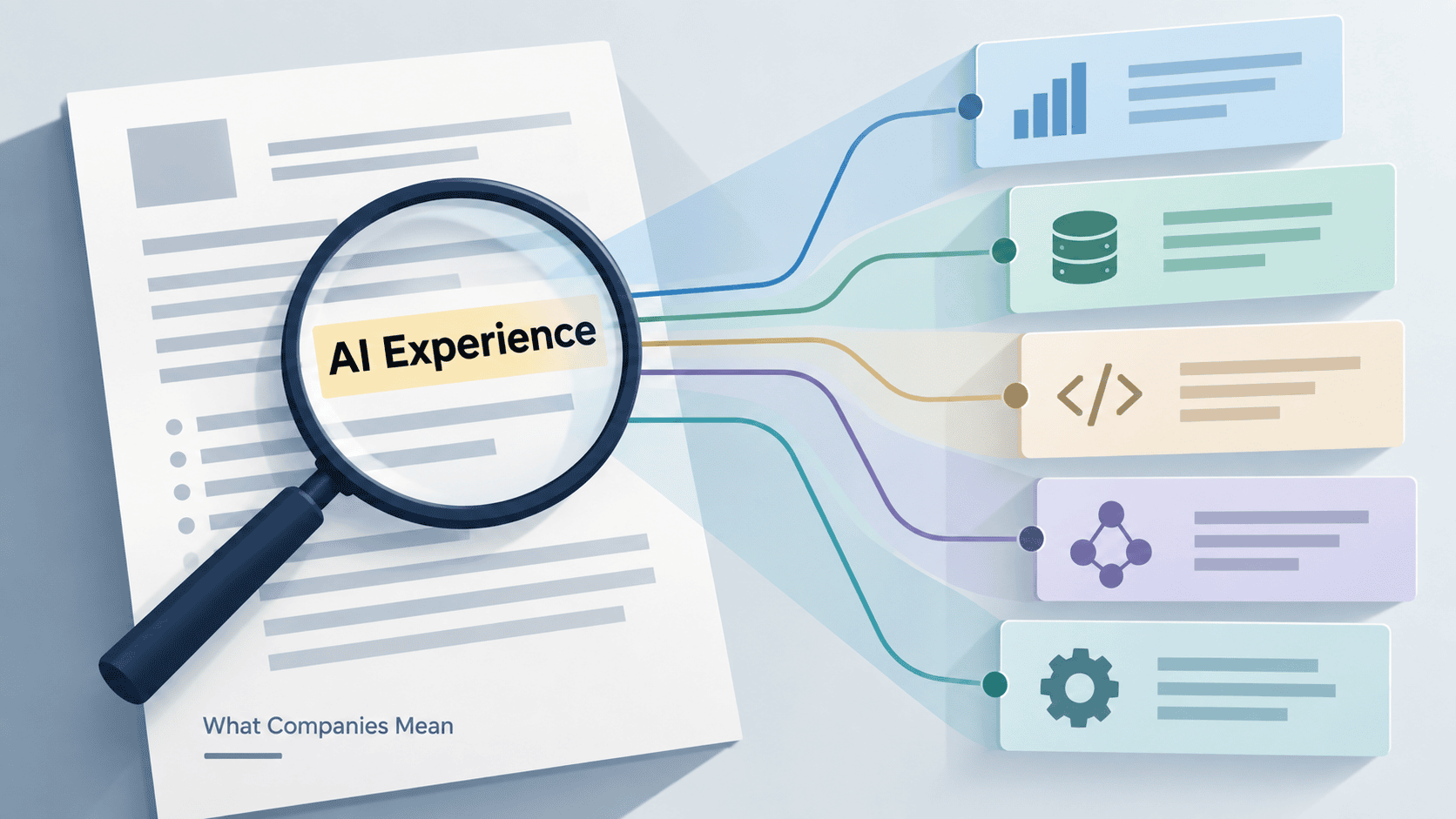
Job postings for data analysts, statisticians, and researchers increasingly list "AI experience" as a requirement. But that phrase means very different things depending on who wrote the listing, what industry they're in, and what problem they're trying to solve. A hiring manager at a retail company, a biotech startup, and a financial services firm may all use the same two words to describe wildly different expectations.
This guide breaks down what employers are actually asking for, how to read between the lines of job postings, and how your existing statistical knowledge maps onto what they call "AI experience."
The Phrase Has No Standard Definition
"AI experience" is a marketing term, not a technical one. Unlike "five years of regression analysis" or "proficiency in R," it carries no shared meaning across organizations.
This ambiguity isn't an accident. Hiring teams often don't fully agree internally on what they want. They write "AI experience" because it signals modernity and filters for candidates who've been paying attention to recent developments — not because they have a precise competency in mind.
Your first job is to decode the listing. The job description itself, the industry context, and the seniority level all carry information that tells you what the company actually needs.
The 4 Categories of "AI Experience"
Most uses of "AI experience" in job postings fall into four distinct categories. Understanding which one applies to a given role changes how you should frame your background.
- Category 1: Familiarity with AI Tools. This is the most common meaning at the entry and mid-level, especially in industries that have recently adopted AI products but don't build them. A marketing analyst role asking for "AI experience" often means they want someone comfortable using tools like automated forecasting dashboards, AI-assisted reporting platforms, or large language model (LLM) interfaces for summarization and drafting. They're not asking you to build anything. They want to know you can evaluate AI outputs with statistical judgment and fold them into existing workflows. If you've used any AI-assisted tool professionally and didn't just trust it blindly, this category applies to you.
- Category 2: Machine Learning Awareness. You'll see this most in tech-adjacent analyst roles. Companies want people who understand the difference between a classification problem and a regression problem, can read a model performance report, and can hold a coherent conversation with the data science team building the models. Note what this isn't asking: it's not asking you to build anything. If you understand concepts like training and test sets, overfitting, and feature importance, you qualify — even without hands-on modeling experience.
- Category 3: Applied Machine Learning. This is what most people assume every "AI experience" requirement means. It's also far less common than the phrase suggests. Roles that genuinely require this are usually titled Data Scientist, Machine Learning Engineer, or Applied Scientist, and they'll say so explicitly in the job description body, not just in a bulleted requirement. Look for language like "experience building predictive models," "familiarity with
scikit-learn," or "experience deploying models to production." If the listing just says "AI experience" in a bullet with no further detail, it almost certainly means Category 1 or 2. - Category 4: Domain-Specific AI Knowledge. In specialized fields, "AI experience" refers to AI applications specific to that domain. Healthcare companies may mean clinical natural language processing (NLP) or imaging analysis pipelines. Legal firms may mean contract review automation. Financial companies may mean fraud detection frameworks or algorithmic trading systems. This is the easiest category to identify because the surrounding job description makes the domain explicit. If you have deep domain experience — even without broad "AI" credentials — this is where your background matters most.
How Your Statistical Background Already Maps to AI Experience
Statistical training is the foundation of almost everything called "AI" in a business context. The gap between "statistician" and "AI practitioner" is largely one of vocabulary and tooling, not underlying reasoning.
You don't need to overhaul your resume. You need to translate it:
- Variance, bias, and model fit map directly to understanding why machine learning models fail.
- Regression analysis maps cleanly to how most supervised learning algorithms work conceptually.
- Hypothesis testing and experimental design are exactly the skills companies need when they want someone to evaluate whether an AI system is actually performing as expected.
Where your resume says "built predictive regression models to forecast quarterly demand," a hiring manager reading for AI experience sees someone who understands supervised learning and model evaluation. Frame your experience around outcomes and reasoning processes, and the connection becomes visible.
Reading the Job Posting as a Statistical Document
Treat a job posting the way you'd treat any dataset: with healthy skepticism and a focus on what the evidence actually supports.
Headline requirements are aspirational. Companies list every skill they'd ideally want, knowing no single candidate will check every box. "AI experience" buried in a list of twelve requirements carries far less weight than you might think. What carries more weight is what appears in the role description body — the day-to-day responsibilities and the problems the role is supposed to solve.
A useful shortcut:
- If the responsibilities involve analyzing business performance, presenting findings to stakeholders, and supporting strategic decisions with data, it's an analytics role with AI awareness requirements (Categories 1 or 2).
- If the responsibilities involve designing, training, evaluating, and deploying models, it's a true machine learning role (Category 3).
The headline requirements often fail to communicate this distinction clearly. The body of the posting usually does.
Also pay attention to the modifiers. "AI experience preferred" is a nice-to-have. "AI experience required" with no further elaboration usually means Category 1 or 2. "Hands-on machine learning experience required" with specific tools listed means Category 3.
The Seniority Signal
The seniority level of a role changes the interpretation of "AI experience" substantially.
| Seniority Level | What They Actually Want | What That Looks Like in Practice |
|---|---|---|
| Junior | Adaptability | Comfort with new tools, willingness to learn internal systems, no fear of AI outputs |
| Mid-Level | Informed Collaboration | Working alongside engineering teams, contributing to model evaluation conversations, bridging the gap between data science and business stakeholders |
| Senior | Strategic Judgment | Knowing when AI is and isn't the right solution, communicating limitations to leadership, helping the org avoid the real costs of deploying it carelessly |
Three Misconceptions Worth Clearing Up
"I should list every AI tool I've ever touched."
This tends to backfire. Hiring managers remember candidates who demonstrated judgment, not candidates who demonstrated access to tools. Describe the problems you solved and the reasoning process you used, then mention tools as supporting context.
"I'm disqualified if I haven't built a machine learning model from scratch."
For the majority of roles using this phrase, you're not. What actually disqualifies candidates more often is an inability to think critically about data quality, model assumptions, and result interpretation. Those are statistical skills — and they're exactly what companies need but often fail to name correctly in their postings.
"I need a certification before I apply."
Credentials help in some contexts. But most hiring managers at the analyst level are evaluating your reasoning in the interview, not scanning your certificate list. Being able to explain when an AI system might be wrong — and why — is more convincing than any completed online course.
Wrapping Up
"AI experience" in a job posting is a starting point for a conversation, not a rigid technical specification. Most of the time it signals one of four things: comfort with AI tools, awareness of machine learning concepts, hands-on modeling experience, or domain-specific AI knowledge. Your statistical background already covers substantial ground across all four. The work is in reading the posting carefully enough to know which category applies, then framing your existing experience so the connection becomes impossible to miss.
Vinod Chugani is an AI and data science educator who bridges the gap between emerging AI technologies and practical application for working professionals. His focus areas include agentic AI, machine learning applications, and automation workflows. Through his work as a technical mentor and instructor, Vinod has supported data professionals through skill development and career transitions. He brings analytical expertise from quantitative finance to his hands-on teaching approach. His content emphasizes actionable strategies and frameworks that professionals can apply immediately.