


SuperWhisper s1-mini: The 600M Parameter Model Built Just for Transcription
This is a summary of, and insights into, what I found digging into the recently-released Superwhisper S1 family of voice-to-text models.
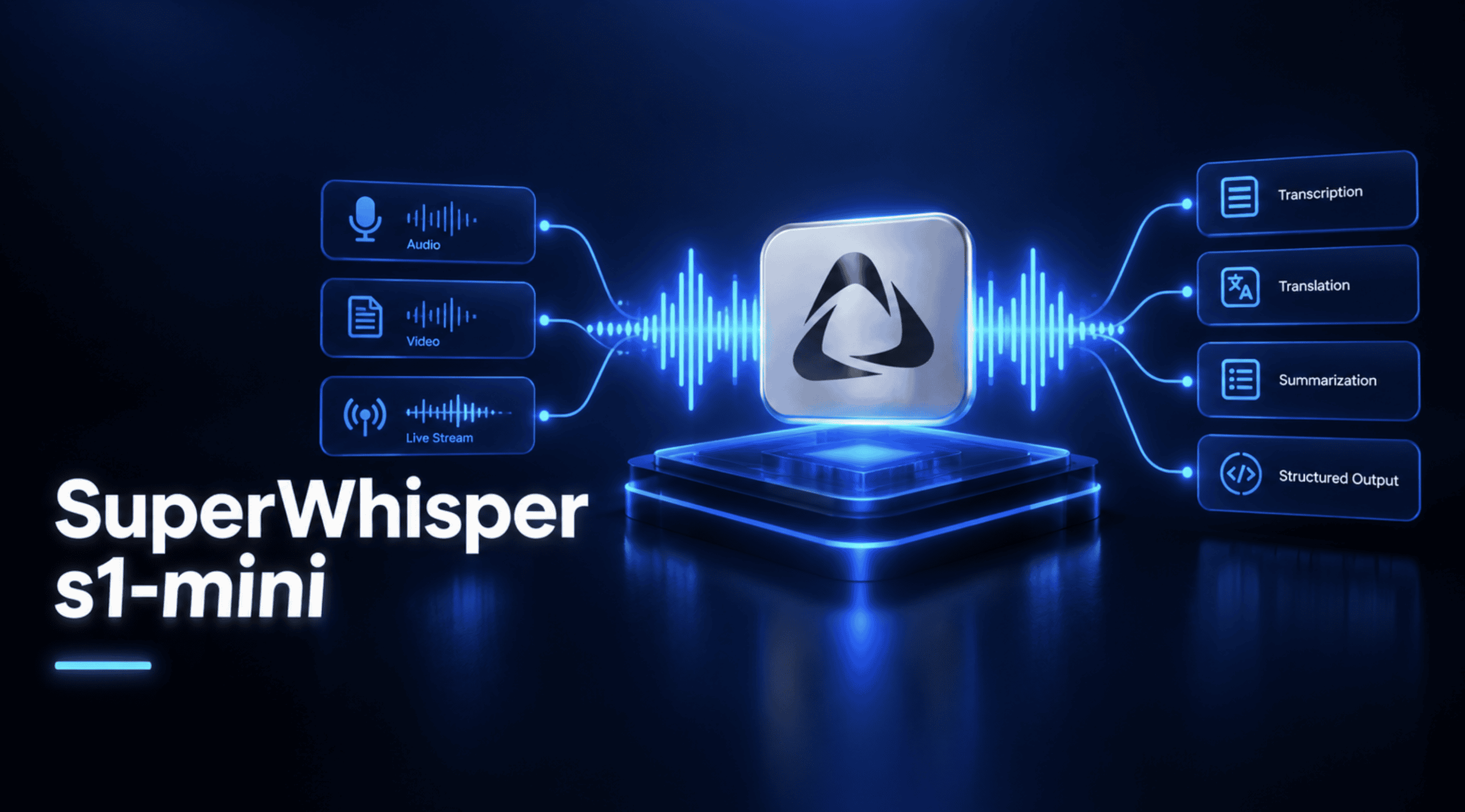
SuperWhisper launched its S1 family on August 19, 2026, three proprietary models — S1-Voice, S1-Language, and S1-mini — built around a specific claim: that voice-to-text tools can be faster and more accurate without training on your data to get there. Two of the three are cloud-hosted. The third, S1-mini, is the one worth a close look on its own: a 0.6-billion-parameter model with open weights that runs entirely on a laptop CPU, doing one narrow job extremely well.
This is a summary plus what I found digging into the actual model card and documentation, not a full deep-dive tutorial.
What's New
S1-Voice is SuperWhisper's own cloud speech-to-text model, replacing whatever ASR engine you'd otherwise wire in. S1-Language is a cloud instruction-following model for heavier cleanup, custom formatting rules, meeting-note structuring, anything beyond simple normalization. S1-mini is the odd one out, and deliberately so: it's the only model in the family with open weights, published directly on Hugging Face, and the only one built to run completely offline with zero network requests.
What's Actually Crazy About It
The interesting part isn't the parameter count; plenty of small models exist. It's the design constraint SuperWhisper put on it. The model card describes it as "ruthlessly obedient": it will never add content you didn't say, never correct a fact, never soften profanity, never flag what you're talking about, never rewrite your dialect. Its entire job is turning a raw, lowercase, unpunctuated ASR transcript into clean written text — nothing more and nothing less. That's a genuinely unusual thing to optimize a language model for; most small models are trained to be broadly helpful, but this one is trained to be narrowly obedient.
The real numbers back up that narrowness paying off. Evaluated on a held-out set of 7,519 English cases across 104 transcripts, none seen during training, it hits 94.8% token accuracy and an 11.6% text-edit error rate. On email-formatted output specifically, it identifies the greeting line correctly 99.3% of the time and the sign-off 97.9% of the time. Fewer than 1% of generations show degenerate behavior like looping or truncation, and when the input is nothing but filler noise, it correctly returns an empty string 98.6% of the time rather than hallucinating content to fill the silence.
Steering it is done through what the model card calls a control line — three independent settings prepended to every input: Styling (casual through formal, controlling capitalization and contraction handling), Structure (prose or lists, and it's deliberately conservative about lists, requiring at least three real items before it'll bullet anything), and Context (general or email, which triggers greeting-line and sign-off formatting). All three axes were trained independently, so every combination genuinely works.
Here's the detail worth flagging clearly, since it's the single most common way people get this model wrong. Because S1-mini is fine-tuned from Qwen3-0.6B, it inherits Qwen3's chat template, which turns on "thinking mode" by default. S1-mini was trained with thinking explicitly off and has zero reasoning traces in its training data. Skip setting enable_thinking=False, and the model emits an empty think block and stops, producing no usable output at all — silently. Not a crash, not an error, just nothing. That's worth memorizing before you touch this model at all.
How It Differs from Other Models in Its Category
Most transcript cleanup right now happens one of two ways: routing raw ASR output through a general-purpose chat model with a cleanup prompt bolted on, or running a much larger local model that can technically do the job but wasn't built for it specifically. S1-mini's bet is that narrowness beats generality here. At 596 million unique parameters (the Hugging Face sidebar shows 0.8B, but that's counting the tied embedding weights twice; the model card is explicit about the actual unique-parameter count), it's small enough to run comfortably on a laptop CPU with no GPU required — something a general 7B or 8B chat model asked to do the same job simply can't match on latency or resource use — while reportedly matching or beating what those larger, unfocused models produce on this one specific task.
How It Differs from SuperWhisper's Own S1-Voice and S1-Language
Within the same company, these three aren't competing tiers of the same product; they're different jobs entirely. S1-Voice is the actual speech-to-text step, turning audio into a raw transcript in the first place, evaluated across eight benchmarks including meeting audio and earnings calls at a 6.8% average word error rate — the lowest of 15 models SuperWhisper tested — and 2.2% on LibriSpeech specifically. S1-Language sits downstream of that, a cloud model for heavier, more custom instruction-following cleanup, built for teams who want meeting notes structured a specific way or emails that consistently sound like them.
S1-mini sits in the same downstream position as S1-Language — cleanup after transcription — but trades S1-Language's cloud-hosted flexibility for offline operation and a much narrower, more predictable scope. SuperWhisper's own recommended pairing makes the split explicit: offline users get S1-mini paired with a local ASR engine, cloud users get S1-Language paired with S1-Voice.
Usage Sample
The real quickstart from the model card, exactly as documented:
from transformers import AutoModelForCausalLM, AutoTokenizer

MODEL = "superwhisper/s1-mini"
tok = AutoTokenizer.from_pretrained(MODEL)
model = AutoModelForCausalLM.from_pretrained(MODEL, torch_dtype="auto")

SYSTEM = (
    "You are a text normalizer for speech-to-text transcripts. The input begins "
    "with a control line specifying the styling, structure, and context settings; "
    "clean the transcript to match those settings and output only the cleaned text."
)

def normalize(transcript, styling="semi-formal", structure="prose", context="general"):
    control = f"[Styling: {styling}] [Structure: {structure}] [Context: {context}]"
    messages = [
        {"role": "system", "content": SYSTEM},
        {"role": "user", "content": f"{control}\n{transcript}"},
    ]
    text = tok.apply_chat_template(
        messages,
        tokenize=False,
        add_generation_prompt=True,
        enable_thinking=False,      # required, see above
    )
    inputs = tok(text, return_tensors="pt").to(model.device)
    out = model.generate(**inputs, max_new_tokens=1024, do_sample=False)
    return tok.decode(out[0][inputs.input_ids.shape[1]:], skip_special_tokens=True)

raw = "so um i need to like send the the report by uh friday no wait make that thursday"
print(normalize(raw))
# I need to send the report by Thursday
What this does: the SYSTEM prompt is not optional boilerplate — it's part of the exact input format the model was trained on; change its wording and output quality degrades. normalize() builds the control line from three plain arguments and prepends it to the raw transcript with a newline, matching the input shape from the training data exactly. enable_thinking=False is the line from the warning above, present here because leaving it out produces the silent empty-output failure. do_sample=False matters too: the model's own generation config already ships greedy decoding by default, and for good reason — normalization is meant to be a deterministic transformation, not a creative one, so sampling only adds variance nobody wants here.
I checked the control-line construction logic directly (the string formatting inside normalize()) against the documented format, confirming it produces [Styling: semi-formal] [Structure: prose] [Context: general] followed by the transcript on the next line — byte-for-byte what the model card specifies as the trained input shape.
For a heavier real case, the model card's own documented email example shows the range this covers in one pass. Raw input: "hey sarah just wanted to follow up on the proposal can you send the numbers by end of week thanks john". With context="email", it returns a properly laid-out message with a greeting line, body, and sign-off separated by blank lines — not just punctuation added to a run-on sentence.
Wrapping Up
If you're building a dictation app, a meeting-notes tool, or anything that pipes raw ASR output toward something a human has to read, S1-mini is worth a real trial specifically because it's small enough to ship on-device and narrow enough to trust not to editorialize your words.
Start with the GGUF quantized build if you're targeting llama.cpp, Ollama, or LM Studio rather than the full BF16 weights — it's a fraction of the size for a documented negligible accuracy cost. One thing worth checking before shipping it in anything commercial: the license is Apache 2.0 plus one extra term — the model has to keep its exact name, "S1-mini" by "Superwhisper," wherever it's used. Worth a quick read of the actual LICENSE file rather than assuming standard Apache 2.0 terms cover you completely.
Shittu Olumide is a software engineer and technical writer passionate about leveraging cutting-edge technologies to craft compelling narratives, with a keen eye for detail and a knack for simplifying complex concepts. You can also find Shittu on Twitter.