


Forward Deployed Engineer: AI’s Hottest New Career, or Consulting With a Better Title?
The forward deployed engineer: is this the hot new AI career, or has the hype cycle rebranded?
Introduction
In January 2025, Indeed barely registered "forward deployed engineer" (FDE) as a job title. By April 2026, postings for the role were running 5,230% above that level — about 729% higher than a year earlier — and OpenAI had raised more than $4 billion for a company built around it.
The earlier signal was already loud. Monthly listings for the role rose more than 800% between January and September 2025, according to an analysis by Indeed and the Financial Times. All of this happened while software development postings on Indeed as a whole remain well below their pre-pandemic level, at 74.4 on an index where February 2020 equals 100.

Growth like that invites a fair question: is this a lasting career, or does the hype cycle have a new name? The answer sits between the two. AI's bottleneck has moved from building models to deploying them, and the FDE is the job that grew up in that gap. The title may splinter or fade; the skill set it names will not.
What a Forward Deployed Engineer Actually Is
An FDE is a software engineer who embeds with a customer, works inside that customer's systems and data, and builds production solutions there. The FDE owns an outcome, not a slide deck or a statement of work.
The role began at Palantir, which sent engineers "forward" to the customer instead of building from headquarters. For years the model was dismissed as a consulting shop in software clothing. Ted Mabrey, Palantir's head of global commercial, argues that dismissal gave the company "a two decade head start on building a software company that is aligned with its customers."
The margins explain why others now want to copy it. Palantir reported an 85% gross margin for the second quarter of 2026, up from 81% a year earlier.
An FDE is defined by whether what they learn at the customer changes what the company builds next. Without that feedback loop, the role is consulting. It isn't sales, either: Bloomberry's analysis of 1,000 FDE postings found that exactly 0% were quota-carrying.
| Role | Primary Goal | Writes Production Code? | Carries Quota? | Feeds Product Roadmap? |
|---|---|---|---|---|
| Forward Deployed Engineer | Customer outcome in production | Yes, heavily | No | Yes, by design |
| Solutions / Sales Engineer | Win the deal | Demos and prototypes | Often | Sometimes |
| IT Consultant | Deliver a scoped project | Varies | No (billable hours) | No |
| Machine Learning Engineer (product team) | Build and ship the core product | Yes | No | Yes, directly |
The last column is the one to watch, because it is where a real FDE role and a renamed consulting role differ.
The Last-Mile Problem: Why Demand Exploded Now
Frontier models keep improving, and they keep converging. When several labs can offer comparable capability, differentiation moves somewhere else: to whoever can make a model work inside a real business. The rest of the AI industry has now hit the wall Palantir hit two decades ago. The technology is capable, and the last mile into the enterprise is still hard.
That last mile rarely fails on the model. It fails on the plumbing around it. A pilot that looked strong in a notebook stalls because the data it needs is in a legacy warehouse, behind permissions nobody on the project can grant. Or it stalls because no one agreed on what a good output looks like for this customer's task, so every stakeholder judges the demo by the last answer they happened to see.
Integration is where the next set of pilots die. A retrieval pipeline that cannot read the ticketing system, or an agent whose tools do not match how the team works, is technically impressive and practically unused.
Then come the organizational problems: an unclear owner, a skeptical department head, a compliance review stuck in a queue. The clock runs the whole time, because time-to-value pressure starts the day the contract is signed, not the day the data is clean.
None of these are research problems. They are engineering problems that can only be solved on site, by someone with enough context to see them and enough technical depth to fix them. Gain America's guide to the role puts it plainly: "The models already work; what is missing is someone embedded deeply enough to wire them into real data, real systems, and real workflows."
The FDE is that someone: an engineer in the room who can prototype, debug, and ship on the spot, then send what they learned back to the product team so the next deployment starts with one fewer of these problems.
The Money Behind the Title: Bets From the Frontier Labs
Recruiter enthusiasm is cheap. The stronger evidence is where strategic capital has gone in 2026.
OpenAI launched the OpenAI Deployment Company on May 11, 2026, backed by more than \$4 billion from 19 investors and organized around FDEs embedded with clients. Its acquisition of the consultancy Tomoro brought roughly 150 FDEs and deployment specialists on day one. OpenAI also hires FDEs directly, at a reported base of \$220K to \$280K plus equity.
Anthropic moved a week earlier. On May 4, it announced a new, standalone enterprise AI services firm with Blackstone, Hellman & Friedman, and Goldman Sachs as founding partners. CNBC reported the venture at \$1.5 billion. It targets mid-sized companies such as community banks and regional health systems, with Anthropic's applied AI engineers working alongside its team. At the time of this article's publication, Anthropic's own careers page lists Forward Deployed Engineer roles, with a manager track, next to Applied AI Engineer and Applied AI Architect roles.
Everyone else is following. Salesforce has committed to a team of 1,000 FDEs for Agentforce. LeadDev reports that AWS has committed to its own FDE organization and that Microsoft's Frontier Company launched with \$2.5 billion behind it. Google Cloud, Databricks, and Adobe are hiring under the title or close variants, as are a number of startups such as Harvey, Sierra, Decagon, and Hebbia.
Even consultancies are hiring for it: Deloitte has posted a listing for an "Anthropic Forward Deployed Engineer." Recruiting platform Paraform says the pool of qualified candidates has not kept pace with demand. If that is right, the gap is what's pushing pay up.
Compensation and the Hiring Map
Pay figures vary widely by source and seniority, and many come from recruiting firms with an interest in the trend, so read each one as a range. Indeed puts the average base salary at \$171,911. Bloomberry's analysis lands close, at a median of \$173,816, and found that 70% of postings mention equity.
At the top, Perspective AI's analysis of 2026 postings puts total compensation at \$300K to \$550K for mid-level and senior FDEs, with staff and principal roles at frontier labs listed from \$600K to over \$1.2 million. Individual bands from a recruiting firm's roundup are more grounded: \$160K to \$270K base for a founding FDE at Glean, and \$161.5K to \$190K plus equity at Ramp.
The jobs cluster in the usual hubs. Anthropic alone lists FDE roles in New York, San Francisco, Seattle, London, Paris, and Munich, and Salesforce posted one in Toronto in late August. The harder thing to pin down is the title, which currently takes at least these forms:
- Forward Deployed Engineer
- Forward Deployed AI Engineer
- Forward Deployed Software Engineer
- Applied AI Engineer
- Deployment or Solutions Engineer
- AI Engineer, FDE (Databricks' phrasing)
Perspective AI estimates that candidates who search only for the literal "forward deployed engineer" miss roughly a third of the live market.
The Skills Profile: Why Data People Are Well Placed
The technical profile is broad rather than deep. It starts with the large language model (LLM) application stack: retrieval-augmented generation (RAG), agents and tool use, and prompt and context engineering. Around that sit data engineering on messy enterprise data, backend and integration work such as APIs, auth, cloud deployment, and observability, and fast prototyping in Python.
One skill in that list deserves more weight than it gets. Designing evaluations for a customer-specific task is the gap the last-mile problem keeps exposing, and data scientists already do it. Defining what "good" means, building a labeled set, and measuring against it is routine data science work, and it is also what the stalled pilot described earlier never had.
The non-technical skills often decide who gets hired. An FDE has to tolerate shifting requirements, turn a business problem into a technical spec, write clearly for stakeholders who will never read the code, and judge what not to build. Interviews reflect that. Paraform describes OpenAI's FDE decomposition round as rewarding "continuous narration of your reasoning, not a polished final answer delivered in silence" — a format closer to deployment work than to an algorithmic puzzle.
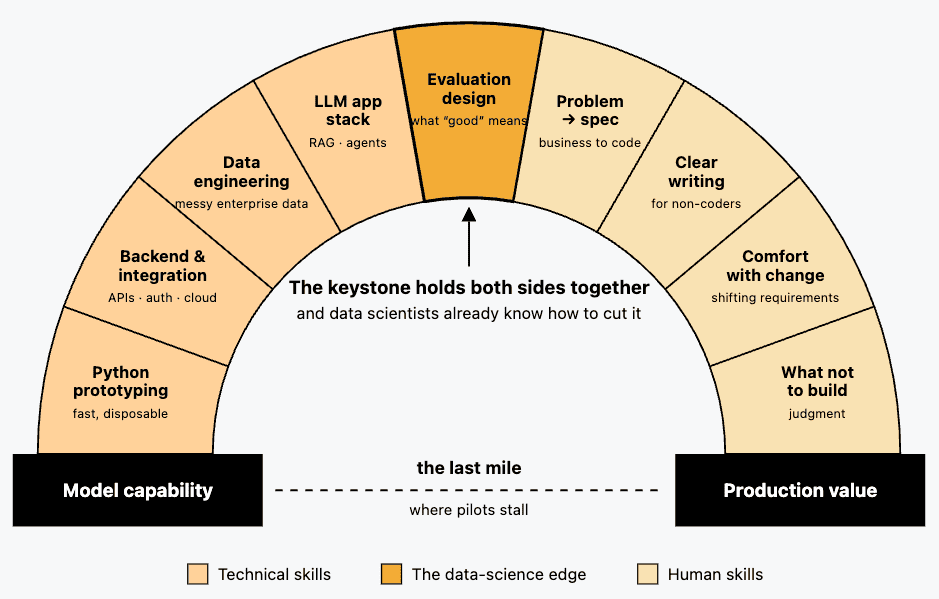
The profile fits data scientists who already work with business stakeholders, machine learning engineers who prefer shipping to research, backend and data engineers who communicate well, and former solutions architects who want deeper technical ownership.
If you want credibility for the move, the evidence that counts is evidence of deployment. Ship an end-to-end LLM application on real, messy data, and write up the evaluation methodology you used. Better still, lead an internal AI rollout: that is an FDE engagement with your own company as the customer.
The Case for "May Be": What the Skeptics Get Right
Start with the numbers, which are real but noisier than they look. For the same role, growth estimates run from 350% (Paraform, first quarter of 2025 to first quarter of 2026) to 729% (Indeed, April year over year) to 1,165% (Bloomberry, January to October 2025 against 2024), depending on who counts and when.
The Indeed figure is an index against a small January 2025 base on a single job board, not a headcount. JobsByCulture's curated live index counted 224 open FDE roles across 39 companies on May 30, 2026. A 5,000% increase from a small base can still describe a small market.
Relabeling is the second problem: companies renaming solutions engineers or consultants without building the feedback loop that makes the role valuable. Writing about Palantir's imitators in 2024, Mabrey concluded: "every replicant I've encountered is a half measure."
The third is what a16z calls trading margin for moat: companies accept lower margins on hands-on deployment work in exchange for becoming hard to replace. Some manage that trade well, and others slide into billable-hours thinking. The warning signs, as one handbook on the role lists them, are performance reviews that mention utilization, features built for customers that never reach the product, and engagements that get extended rather than concluded.
Then there is the cost to the engineer. OpenAI's FDE spec asks for up to 50% travel, and 68% of the postings Bloomberry analyzed require some. Add constant context-switching, months as the company's face at a client, and accountability for adoption the FDE does not control, and burnout is a structural risk. The same handbook warns that two years of integration glue can wear down systems-level depth, which makes the move back to core product engineering harder than it looks.
Conclusion
The title may be a fad. The skill set is not. "Forward deployed engineer" could splinter into a dozen variants, fade the way other hot titles have, or merge into "applied AI engineer" — a drift already visible on Anthropic's careers page, where the two titles sit side by side. But the need behind it, turning model capability into production value inside messy organizations, will last as long as AI adoption lags AI capability. Every deployment venture launched in 2026 is a bet that the gap will not close quickly.
That is why the role is a strong career bet even if the label does not survive. FDE work builds skills that travel: technical range, customer judgment, and a close view of how AI projects actually fail. The most natural exit paths reflect that: product management, founding a company, applied AI engineering, and solutions leadership. Watching real deployments stall at the same points, engagement after engagement, is also a practical education in what to build next.
Not every job with the title will give you that, so screen the offer before you accept it. A few questions that separate a real FDE role from a rebadged one:
- Who on the product team reads what FDEs learn in the field, and how often?
- Is anything in the performance review measured in utilization or billable hours?
- How does an engagement end, and how often do engagements get extended instead?
- Does code written for one customer ever become platform code?
- Can the hiring manager show you something an FDE built last quarter that is now in a product?
That last question, taken from the same handbook, is the one to press on. All five come down to a single test: does what you learn at the customer actually reach the product roadmap?
If it does, you are looking at a real FDE role, and one of the best seats in AI right now. If it doesn't, it's consulting with a better title. Negotiate accordingly.
Matthew Mayo (@mattmayo13) holds a master's degree in computer science and a graduate diploma in data mining. As managing editor of KDnuggets & Statology, and contributing editor at Machine Learning Mastery, Matthew aims to make complex data science concepts accessible. His professional interests include natural language processing, language models, machine learning algorithms, and exploring emerging AI. He is driven by a mission to democratize knowledge in the data science community. Matthew has been coding since he was 6 years old.