

Agentic RAG vs. Naive RAG: When Your Retrieval System Should Think for Itself
From static retrieval pipelines to autonomous reasoning engines: a complete breakdown of how these two architectures work, where each falls short, and how to choose the right one for your use case.
Large language models are remarkable text generators, but they have a well-documented weakness: they hallucinate. Without access to verified, up-to-date information, they confidently produce plausible-sounding answers that are factually wrong. Retrieval-Augmented Generation (RAG) emerged as the standard solution, grounding model outputs in external knowledge sources and dramatically reducing hallucinations across enterprise applications.
But as organizations push these systems into more complex workflows, a new problem has surfaced. Standard RAG pipelines are linear — they retrieve once, pass those results to the model, and generate an answer. When the query is simple and the knowledge base is well-structured, this works fine. When the query requires multi-step reasoning, cross-referencing multiple sources, or synthesizing information that doesn't exist in a single document, the pipeline starts to crack.
That's where Agentic RAG comes in. Rather than treating retrieval as a single, fixed step, it gives the system the ability to reason about how to search, evaluate what it finds, and iterate until it reaches a satisfying answer.
We'll break down how both architectures work, look at where standard RAG hits its limits, and walk through the specific capabilities that make agentic systems better suited for complex tasks. By the end, you'll have a clear framework for deciding which approach fits your next project.
The Baseline: Understanding Naive RAG
Before examining where retrieval systems are going, it helps to be precise about where they started.
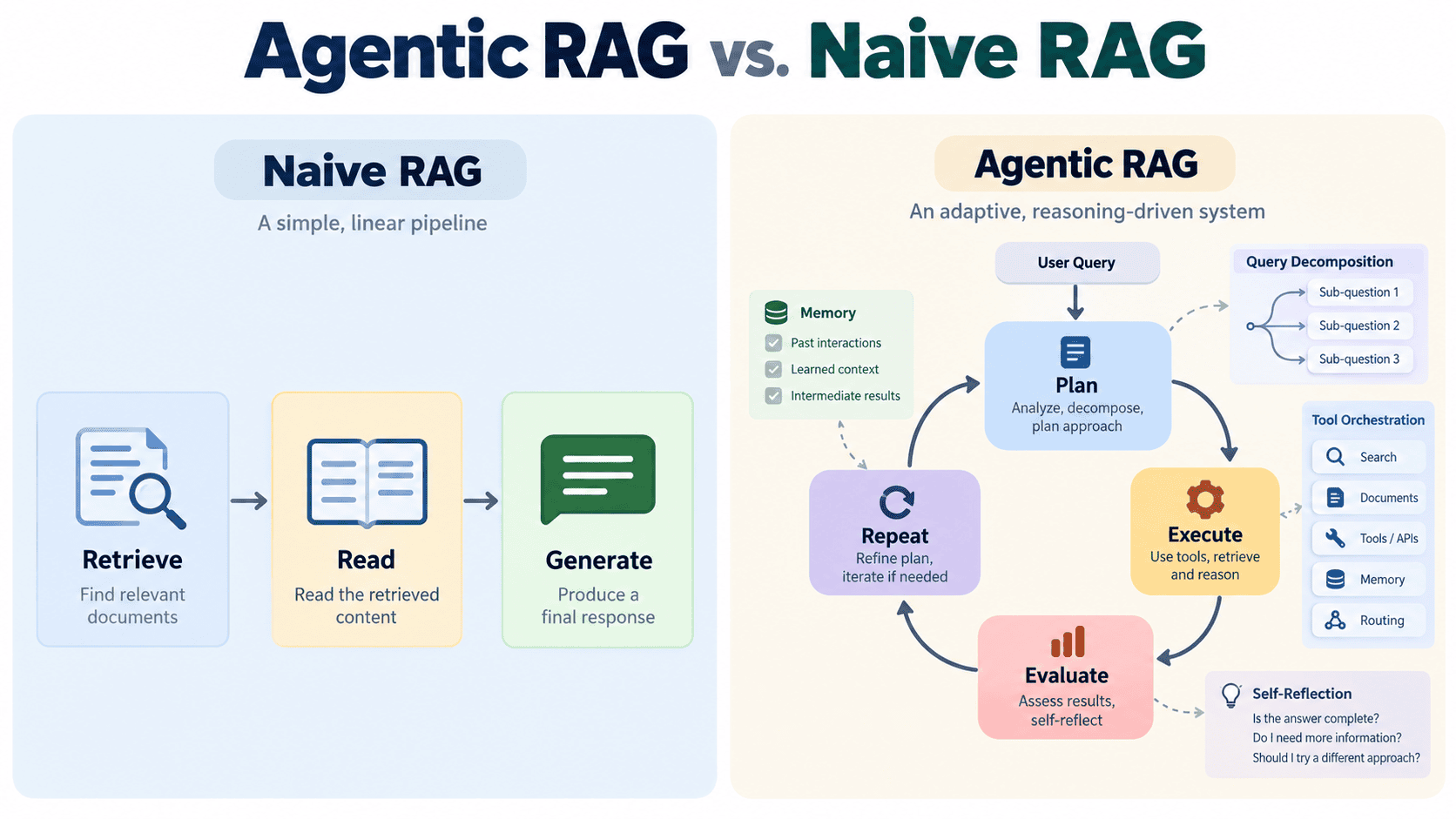
Naive RAG — also called standard RAG — follows a rigid three-stage pipeline: Retrieve → Read → Generate. A user submits a query, the system converts it into a vector embedding, runs a similarity search against a vector database, retrieves the top-k most relevant document chunks, and passes those chunks to the large language model (LLM) as context. The model then generates a response based on what was retrieved.
Think of it like a student preparing for an exam in a large library. Naive RAG is the student who types a single keyword into the catalog, grabs the first three books on the shelf, and writes an essay based only on what's in front of them — without stopping to check whether those sources actually answer the question.
Under the hood, here's what happens. When documents are ingested, they're split into chunks and converted into dense vector representations using an embedding model. These vectors are stored in a database optimized for approximate nearest-neighbor search. At inference time, the user's query is embedded using the same model, and the database returns the chunks whose vectors are closest in high-dimensional space. Those chunks are then injected into the LLM's context window as a reference.
This was a genuine breakthrough. Naive RAG made it possible to build enterprise Q&A systems, internal knowledge assistants, and document summarizers that stayed grounded in verified sources. For many applications, it remains an excellent and cost-effective choice.
The Bottleneck: Where Naive RAG Breaks Down
The architecture's core weakness is its linearity. A single retrieval pass either succeeds or it doesn't. If the initial query is poorly formed, if the relevant information is spread across multiple documents, or if the answer requires reasoning across several steps, the pipeline has no way to recover.
The Single-Pass Limitation
Naive RAG gets one shot at retrieval. If the query's embedding doesn't return the right chunks, the model is left generating a response from incomplete or irrelevant context. It can't recognize that the retrieval failed, and it can't try a different approach.
Multi-Hop Reasoning Failures
Consider a query like: "What regulatory policies does the company that acquired WhatsApp follow in the European Union?"
Answering this correctly requires at least two steps:
- Identify that Meta acquired WhatsApp.
- Retrieve Meta's EU regulatory policies.
A single vector search against "WhatsApp EU regulatory policies" will likely fail to bridge that connection — especially if those two pieces of information live in separate documents. Naive RAG has no way to decompose this into sequential sub-questions, retrieve the intermediate answer, and then use it to inform a second search.
Susceptibility to Bad Retrieval
When the top-k results are genuinely irrelevant to the query, the LLM faces an impossible situation. It either generates a response that ignores its grounding context (which produces hallucinations) or outputs an honest but unhelpful "I don't have enough information to answer." In high-stakes enterprise settings, neither outcome is acceptable.
Agentic RAG: Giving the System a Brain
Agentic RAG reframes the retrieval problem entirely. Instead of treating the LLM as a passive text generator that receives context and produces output, it treats the LLM as an autonomous reasoning engine that actively orchestrates the entire retrieval process.
Where Naive RAG is a pipeline, Agentic RAG is a loop: Plan → Execute → Evaluate → Repeat.
Back to the library analogy. A dedicated research assistant doesn't just grab the first three books and start writing. They read the initial sources, notice a key piece of evidence is missing, open a different database, cross-reference two conflicting claims, and only sit down to write once they're confident their sources are sufficient. Agentic RAG builds that behavior into the retrieval system itself.
The LLM is no longer a consumer of retrieved context — it's the orchestrator, deciding what to retrieve, where to retrieve it from, whether the results are good enough, and what to do if they aren't. This transforms retrieval from a fixed pre-processing step into a dynamic, self-correcting process.
The core shift: in Naive RAG, the model sees the retrieved context once. In Agentic RAG, the model reasons about the retrieval itself, deciding when to search, what to search for, and when it has enough information to generate a reliable answer.
Four Mechanisms That Make RAG Agentic
The difference between a naive and agentic pipeline isn't a single design choice — it's the accumulation of four distinct mechanisms, each addressing a specific failure mode that linear retrieval can't handle on its own.
Query Routing
Not all questions belong to the same data source. A financial analysis query might be best answered by querying a structured SQL database. A policy question might call for semantic search across unstructured documents. A request for current events might need a live web search.
Query routing gives the system the ability to decide where to search before executing the search. The LLM examines the incoming query and selects the appropriate tool or data source from a predefined registry. This prevents the common failure mode of forcing every query through a single retrieval mechanism regardless of whether it fits.
Query Decomposition
Complex questions almost always contain multiple sub-questions, and an agentic system handles this by breaking the original prompt into smaller, independently answerable components before executing any retrieval at all.
Back to the WhatsApp example: the system doesn't search for "WhatsApp EU regulatory policies" as a single phrase. Instead, it first asks which company acquired WhatsApp, retrieves that answer (Meta), and then uses that intermediate result to construct a second, more precise query about Meta's EU regulatory obligations. Each answer informs the next search, building toward a complete response through a chain of targeted retrievals rather than a single broad one. This sequential reasoning is precisely what naive pipelines can't do.
Self-Reflection and Critique
This is the most consequential capability in the agentic toolkit — and the one that most clearly separates it from standard pipelines. After retrieval, the system doesn't immediately forward the results to the generation step. It pauses and evaluates: do these retrieved chunks actually answer the question? Are they relevant, or did the search surface noise?
If the model determines that the retrieved context is insufficient, contradictory, or off-target, it rewrites the query and initiates a new retrieval pass. This evaluation-and-retry loop continues until the system reaches a satisfactory confidence threshold or hits a predefined iteration limit — which prevents runaway loops from inflating cost and latency. The result is a system that can catch its own retrieval failures in real time, rather than silently passing bad context to the generator.
Tool Use and Function Calling
Agentic RAG systems aren't limited to querying text databases. Through function calling, the LLM can invoke external tools mid-reasoning: a calculator for arithmetic, a live web search API for current events, a SQL executor for structured data, or a custom internal API for domain-specific lookups. The model decides which tool is appropriate for each sub-task and invokes it as part of the same reasoning loop.
This is a meaningful expansion of what a retrieval system can do. Rather than a document retriever that hands off to a generator, an agentic system becomes a general-purpose reasoning engine — one that can combine retrieved text with live computation, structured database queries, and real-time data in a single coherent response. The available tools, not the query type, determine what the system can answer.
Making the Choice: When to Use Which
The decision between Naive RAG and Agentic RAG comes down to a trade-off between cost and capability.
Naive RAG involves a single embedding operation and one LLM call. Latency is low, costs are predictable, and the system is easy to debug. Agentic RAG involves multiple LLM reasoning steps, each of which adds latency and token cost. A query that requires three retrieval iterations and two tool calls will cost significantly more than a single-pass retrieval.
Choose Naive RAG when:
- The queries are well-defined and single-hop in nature
- Speed is the primary user expectation (consumer-facing chatbots, internal FAQ systems)
- The knowledge base is well-structured and a single semantic search reliably surfaces the right information
- Budget constraints make multiple LLM calls per query unsustainable at scale
Choose Agentic RAG when:
- Queries require reasoning across multiple documents or data sources
- The use case demands high accuracy over fast responses (financial analysis, legal research, medical literature review)
- Users will ask complex, open-ended questions that can't be anticipated at design time
- The system needs to interact with external tools, APIs, or live data alongside a static knowledge base
- Incorrect answers carry significant business or reputational risk
For many production systems, a hybrid approach makes sense: route simple, high-volume queries through a fast naive pipeline, and reserve the agentic loop for queries that the system flags as complex or high-stakes.
Recommended Learning Resources
For readers who want to go deeper on RAG architectures and agentic systems, these are solid starting points:
- LangChain and LlamaIndex documentation: Both frameworks have extensive guides on building naive and agentic RAG pipelines, including implementations of query routing, query decomposition, and self-reflection loops.
- "RAG Survey" by Gao et al. (2023): An academic overview of RAG architectures, covering naive, advanced, and modular variants with empirical comparisons.
- DeepLearning.AI's "Building and Evaluating Advanced RAG" short course: A practical, code-first introduction to moving beyond basic retrieval pipelines.
- Anthropic and OpenAI function calling documentation: Essential reading for implementing tool use in agentic systems.
Final Thoughts
The distinction between Naive RAG and Agentic RAG maps onto a broader pattern in system design: the difference between a rigid pipeline and an adaptive loop.
Naive RAG retrieves. Agentic RAG investigates. For use cases where a single, well-formed search reliably surfaces the right answer, the simpler architecture is the right choice. For use cases involving multi-step reasoning, heterogeneous data sources, or high accuracy requirements, the added complexity of an agentic loop pays for itself.
The frameworks to build these systems are mature, well-documented, and accessible. The right starting point is simply understanding which problem you're actually trying to solve.
Vinod Chugani is an AI and data science educator who bridges the gap between emerging AI technologies and practical application for working professionals. His focus areas include agentic AI, machine learning applications, and automation workflows. Through his work as a technical mentor and instructor, Vinod has supported data professionals through skill development and career transitions. He brings analytical expertise from quantitative finance to his hands-on teaching approach. His content emphasizes actionable strategies and frameworks that professionals can apply immediately.