


7 Small Specialist Models That Beat Giant LLMs at One Job
Meet seven open specialist models under 10 billion parameters that rival much bigger systems at one job each, from transcription and OCR to routing and speech.
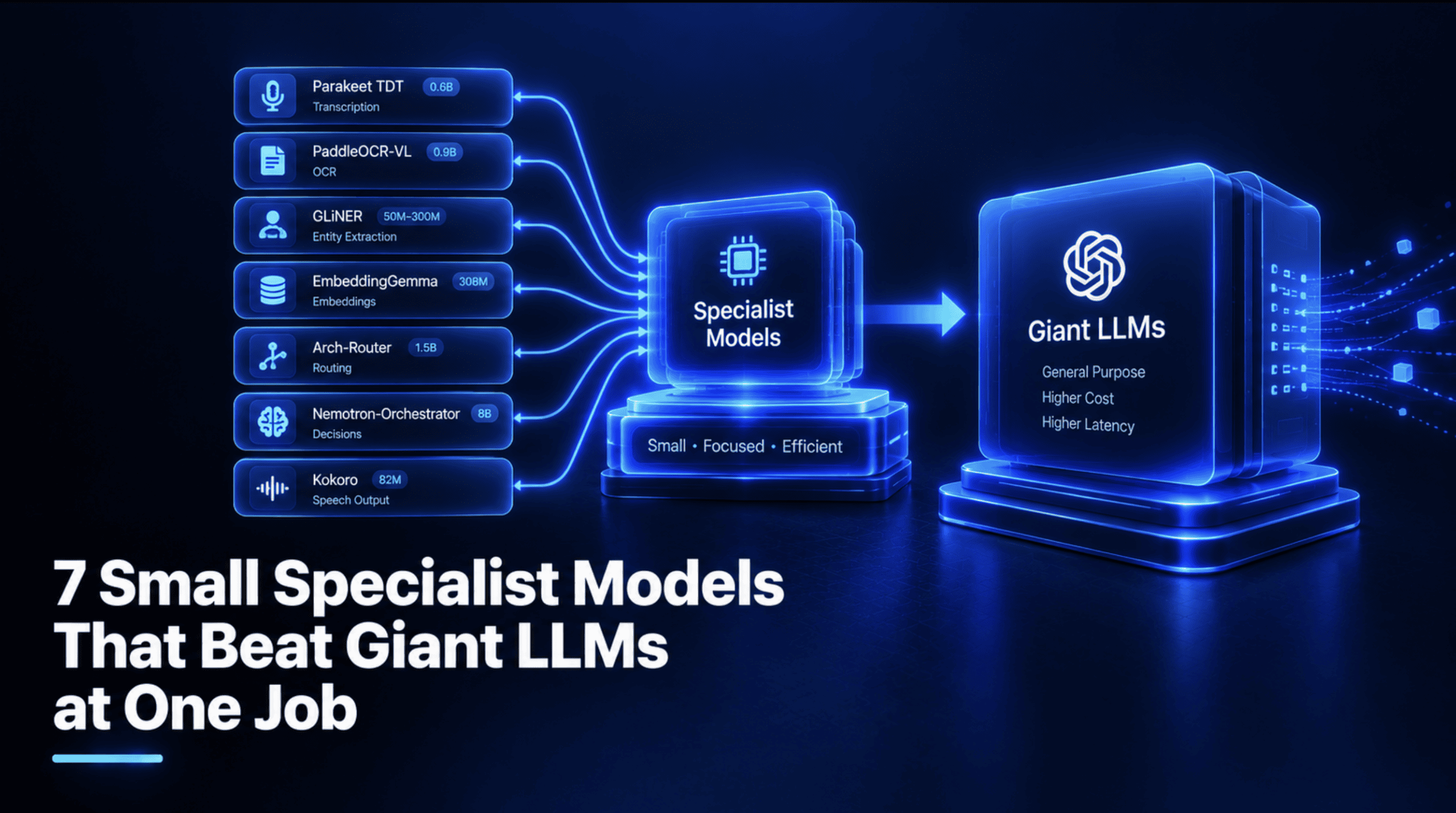
Picture a support pipeline built the lazy way. A giant model transcribes the call, reads the attached invoice, pulls out the names and amounts, decides which team gets the ticket, and reads the reply back to the customer. It works, and every step is billed at frontier prices.
Most of those steps are single jobs, and small specialist models are built for exactly that. In this article, you will meet seven open models, each under 10 billion parameters, that go head to head with much bigger systems on one task. For each, you get the job it wins, its size and license, the published proof, and code to run it locally. These task-specific models won't replace a giant large language model (LLM) everywhere, and the last section covers where they don't.
How These Seven Were Picked
Every model had to meet four rules: open weights, one clear job, published proof against something much bigger, and a footprint small enough for a single machine. "Giant" does not always mean "a chat LLM." Where the proof is against a bigger general model, I say so. Where it is against a closed API or a larger specialist, I say that instead.
The Seven at a Glance
| # | Job | Model | Size | License | What it beats |
|---|---|---|---|---|---|
| 1 | Transcription | Parakeet TDT 0.6B v3 | 0.6B | CC-BY-4.0 | Whisper large-v3, on accuracy and speed |
| 2 | Optical character recognition (OCR) | PaddleOCR-VL-1.6 | 0.9B | Apache 2.0 | Gemini 3 Pro and GPT-5.2 on OmniDocBench v1.6 |
| 3 | Entity extraction | GLiNER | 50M to ~300M | Check per checkpoint | ChatGPT on zero-shot named entity recognition (NER) |
| 4 | Embeddings | EmbeddingGemma | 308M | Gemma terms | Open embedding models under 500M |
| 5 | Routing | Arch-Router | 1.5B | Katanemo license | GPT-4o and Claude-Sonnet-3.7 on routing |
| 6 | Decisions | Nemotron-Orchestrator-8B | 8B | NVIDIA License (research only) | GPT-5 on Humanity's Last Exam |
| 7 | Speech output | Kokoro-82M | 82M | Apache 2.0 | Larger open text-to-speech (TTS) models in blind listening tests |
Setting Up
Use a separate virtual environment for each model. These stacks pin different versions of PyTorch and related libraries, and mixing NeMo, Paddle, and vLLM in one environment is asking for conflicts.
# One environment per model, for example for the first one
python -m venv parakeet-env
source parakeet-env/bin/activate   # Windows: parakeet-env\Scripts\activate
Two models need a little extra. EmbeddingGemma is gated, so accept its license on the model page and log in once:
from huggingface_hub import login

login()  # paste a Hugging Face access token when prompted
Kokoro needs the espeak-ng system package (sudo apt-get install espeak-ng on Ubuntu or brew install espeak-ng on macOS), as its GitHub page notes.
That login() call stores your token so later downloads of gated models work without more prompts. Each model downloads its weights on first run, so expect a wait the first time.
Let's take a look at the seven models. They run in pipeline order: speech in, documents in, extraction, search, routing, decisions, speech out.
1. Parakeet TDT 0.6B v3: Transcription
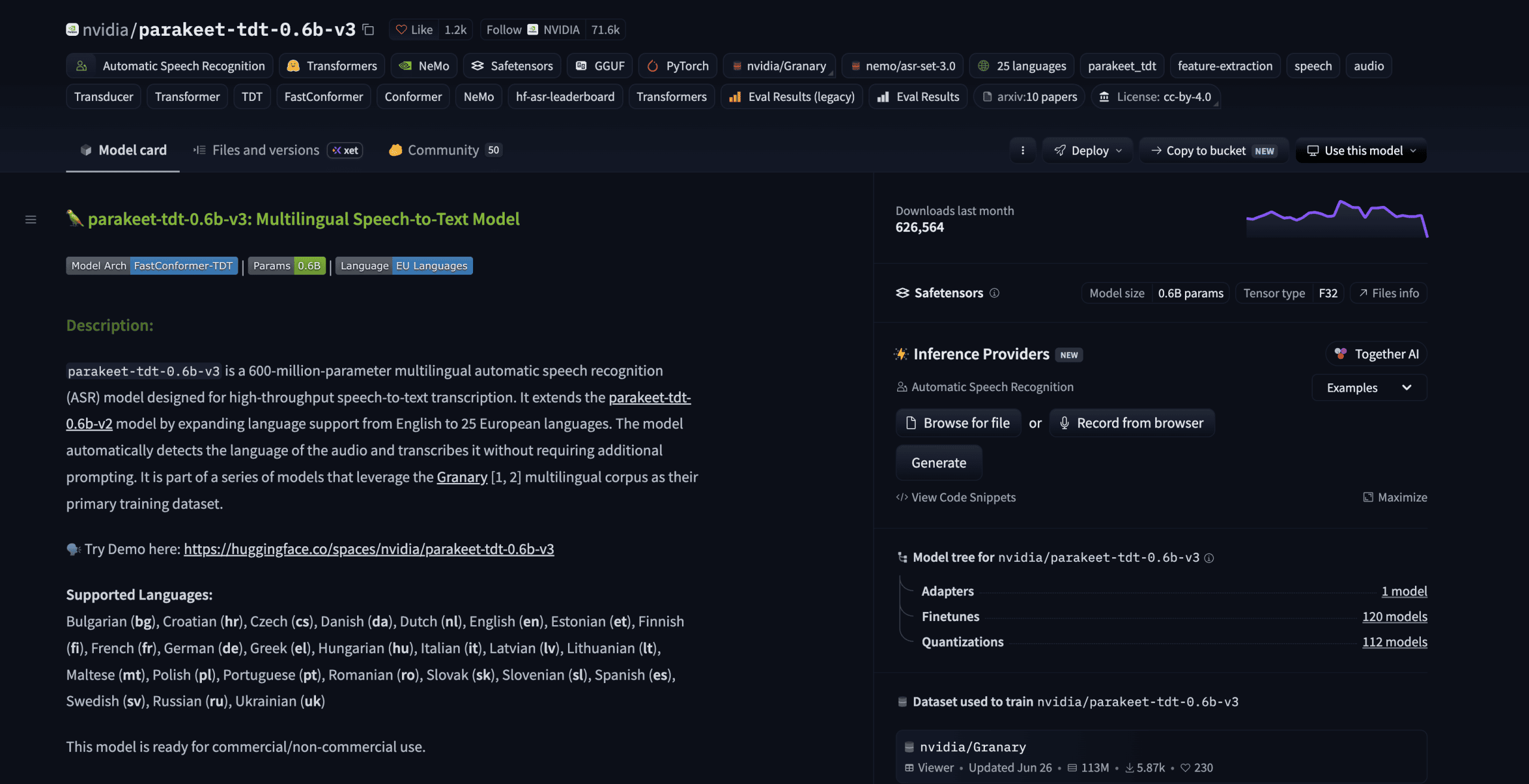
Size and license: 600M parameters, CC-BY-4.0, 25 European languages with automatic language detection, per the model card.
The proof: The Open ASR Leaderboard paper lists Parakeet v3 at an average word error rate of 6.32 against 7.44 for Whisper large-v3, with a throughput of 3,330 against 146 (RTFx, higher is faster). That is about 23 times faster with fewer errors. One roundup puts Parakeet at a quarter of Whisper large-v3's size. Note that this beats a bigger speech model, not a chat LLM.
Run it:
pip install -U "nemo_toolkit[asr]"import nemo.collections.asr as nemo_asr
# Downloads the model on first run; the card says to allow at least 2 GB of RAM
asr_model = nemo_asr.models.ASRModel.from_pretrained(
model_name="nvidia/parakeet-tdt-0.6b-v3"
)
# Pass a list of audio files; 16 kHz mono audio is what the model expects
output = asr_model.transcribe(["meeting.wav"])
print(output[0].text)
# Add timestamps=True to also get word-level timing
# output = asr_model.transcribe(["meeting.wav"], timestamps=True)from_pretrained pulls the checkpoint from Hugging Face and builds the model. transcribe takes a list, so you can batch several files in one call, and each result has a .text field with the transcript. The commented line shows the timestamp option from the model card.
The catch: Whisper still covers 99 languages to Parakeet's 25. An October 2026 leaderboard snapshot shows Parakeet ahead in English (5.66% against 6.5% error) but behind Whisper on five of the six other European languages it tracks.
2. PaddleOCR-VL-1.6: Optical Character Recognition
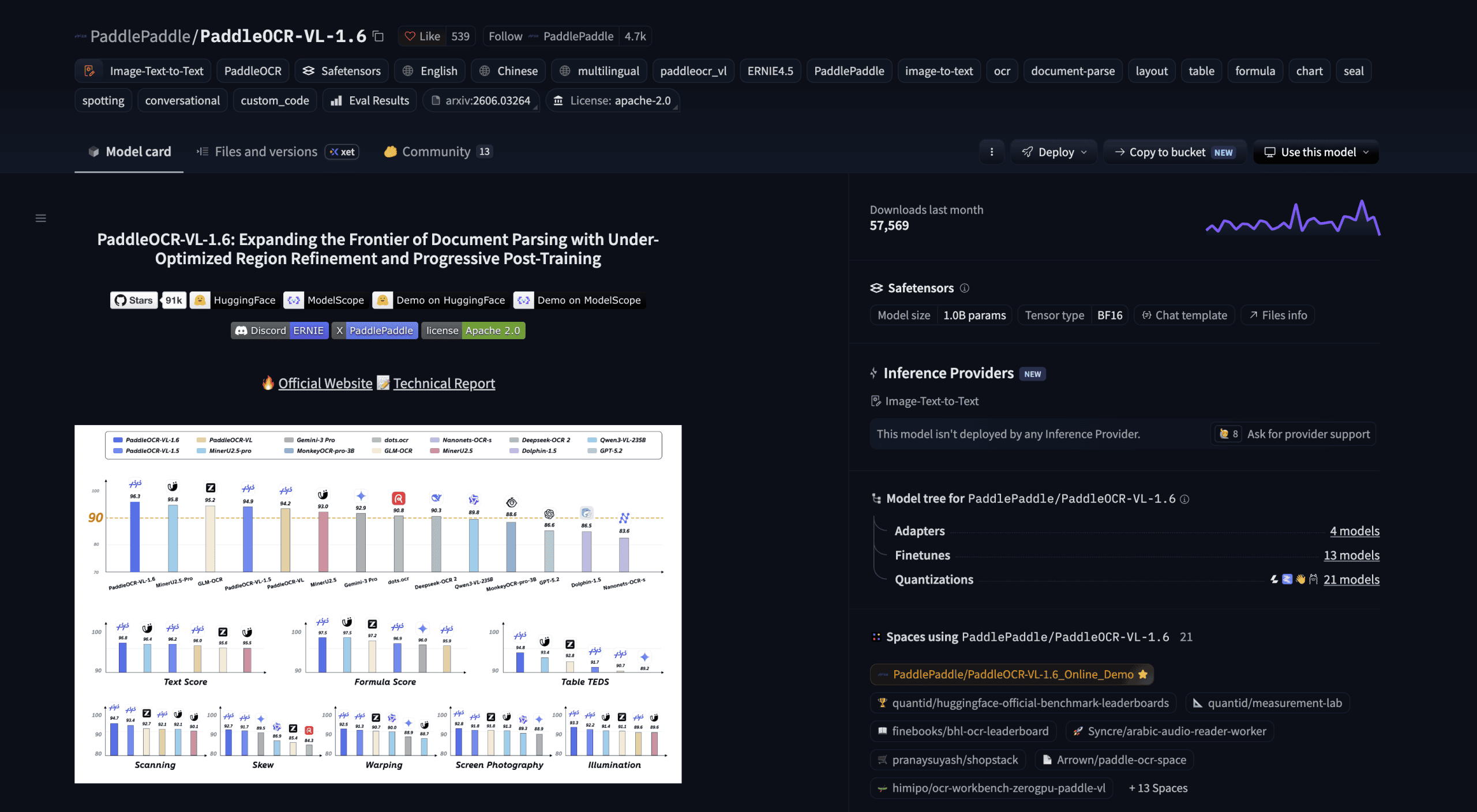
Size and license: 0.9B parameters, released May 28, 2026 according to the model card, and listed as Apache 2.0 in a September 2026 OCR roundup.
The proof: In the PaddleOCR-VL-1.6 paper, its overall score on OmniDocBench v1.6 is 96.33, against 92.91 for Gemini 3 Pro and 86.59 for GPT-5.2. A 0.9B model is ahead of both frontier systems on document parsing.
Run it:
# GPU build for CUDA 12.6, as on the model card (use the CPU build from the Paddle install guide if you have no GPU)
python -m pip install paddlepaddle-gpu==3.2.1 -i https://www.paddlepaddle.org.cn/packages/stable/cu126/
python -m pip install -U "paddleocr[doc-parser]>=3.6.0"
from paddleocr import PaddleOCRVL
# pipeline_version="v1.6" selects this release (it needs paddleocr >= 3.6.0)
pipeline = PaddleOCRVL(pipeline_version="v1.6")
# Accepts a local path or a URL to a page image
output = pipeline.predict("invoice.png")
for res in output:
res.print() # show the parsed result
res.save_to_json(save_path="output") # structured output
res.save_to_markdown(save_path="output") # readable Markdown, tables includedThe pipeline runs layout detection first, then the 0.9B model reads each region. One call gives you the page as JSON and as Markdown, which is easier to feed to the next step than raw text.
The catch: It is not alone at the top. The same September roundup ranks TeleOCR (96.91) and OvisOCR2 (96.47) just above it on OmniDocBench v1.6, so read "top three," not "number one." The original model card also recommends Windows Subsystem for Linux or Docker on Windows.
3. GLiNER: Entity Extraction
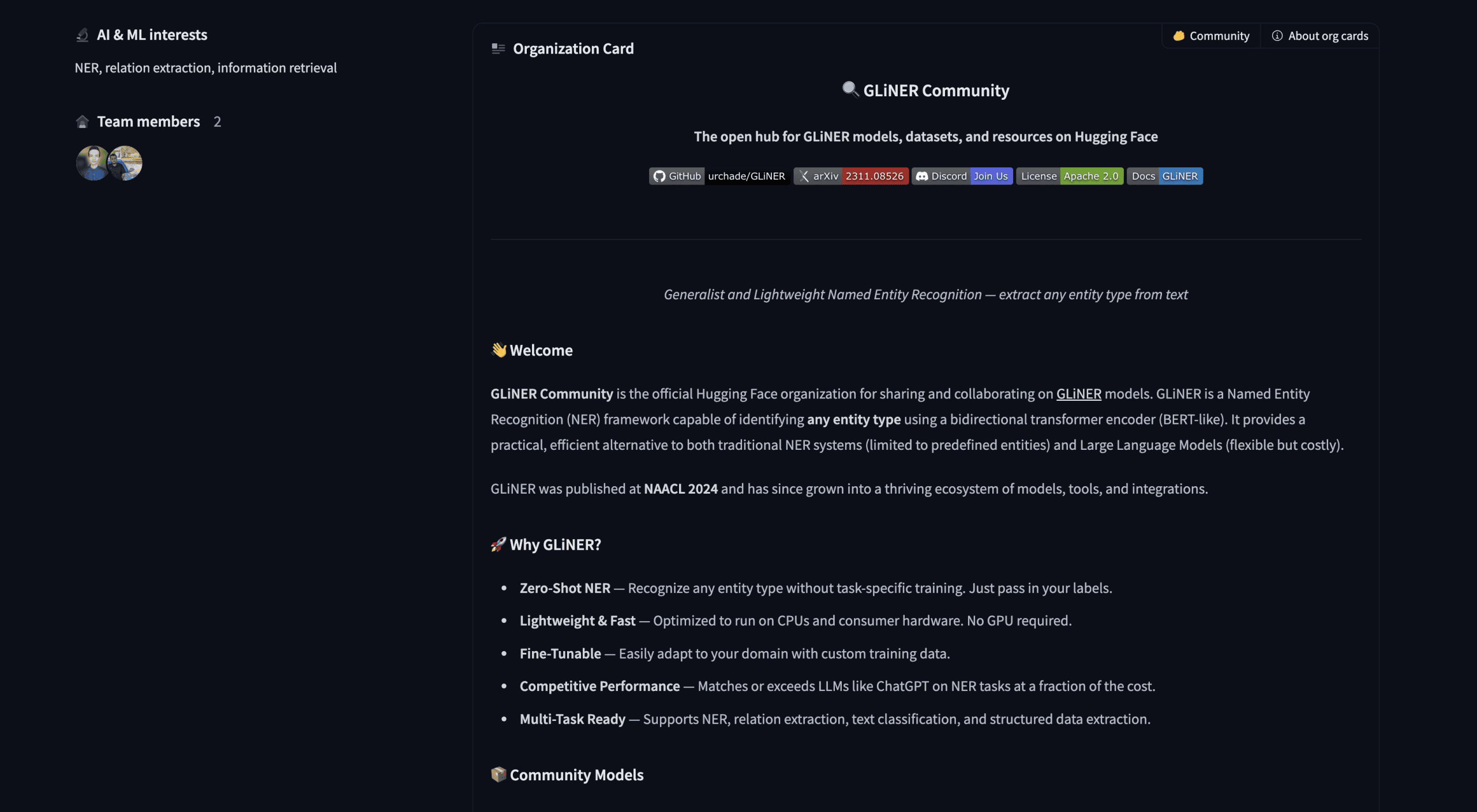
Size and license: The NAACL 2024 paper covers models from 50M parameters up. The repo is Apache-2.0, but individual checkpoints differ, and some older ones are listed as CC BY-NC 4.0, so check the checkpoint you pick.
The proof: The paper's out-of-domain table has GLiNER-S, at 50M parameters, averaging 52.7 against 47.5 for ChatGPT on zero-shot NER. Its abstract says GLiNER outperforms both ChatGPT and fine-tuned LLMs in zero-shot evaluations.
Run it:
pip install glinerfrom gliner import GLiNER
# A 90M-class checkpoint; the repo lists this one as Apache 2.0
model = GLiNER.from_pretrained("urchade/gliner_medium-v2.1")
text = (
"Sarah Okafor from Brightwave Ltd confirmed invoice INV-20418 "
"for $12,400, due on 14 November 2026."
)
# You choose the labels at run time; the README suggests title case for v2.1
labels = ["Person", "Company", "Invoice number", "Amount", "Date"]
entities = model.predict_entities(text, labels, threshold=0.5)
for e in entities:
print(f"{e['text']} => {e['label']} ({e['score']:.2f})")The key idea is that labels are just strings you pass in, so you can change what you extract without retraining. threshold controls strictness: raise it for fewer, surer matches. It runs on a plain CPU, as the README says.
The catch: The "ChatGPT" in that comparison is the 2023-era model. GLiNER extracts spans of text. It won't reason about them or fill in anything missing.
4. EmbeddingGemma: Embeddings

Size and license: 308M parameters, about 100M of them in the model and 200M in embeddings, per Google's announcement. The license is Google's Gemma terms, and the repo is gated.
The proof: Google calls it the highest-ranking open multilingual text embedding model under 500M parameters on MTEB, trained on 100+ languages and small enough to run in under 200 MB of RAM with quantization. Honest framing: that is a claim about its size class, not a win over a giant LLM. It earns its place because retrieval is a job where a 300M model does the work cheaply.
Run it:
pip install -U sentence-transformersfrom sentence_transformers import SentenceTransformer
# Gated model: accept the license on the Hugging Face page and run login() first
model = SentenceTransformer("google/embeddinggemma-300m")
query = "How do I reset my password?"
documents = [
"To reset your password, open Settings and choose Security.",
"Invoices are emailed on the first day of each month.",
"Our office is closed on public holidays.",
]
# These methods add the model's recommended query and document prompts for you
query_embedding = model.encode_query(query)
document_embeddings = model.encode_document(documents)
# One similarity score per document; the highest is the best match
scores = model.similarity(query_embedding, document_embeddings)[0]
best = int(scores.argmax())
print(documents[best], float(scores[best]))encode_query and encode_document matter. The Hugging Face guide explains that they apply the right prompt prefixes automatically, which you would otherwise have to add by hand. similarity returns a score for every query and document pair.
The catch: Context is 2,048 tokens, so long documents need chunking. A larger embedder like jina-embeddings-v5-text-small posts higher MTEB scores at about 677M parameters, if you can spare the size.
5. Arch-Router: Routing

Size and license: 1.5B parameters, fine-tuned from Qwen2.5-1.5B-Instruct on 43,000 examples, per VentureBeat. The license is Katanemo's own research license, not Apache, so read it before shipping.
The proof: The paper reports a 93.17% overall routing score, 7.71% above the proprietary models it tested (GPT-4o and Claude-Sonnet-3.7 among them) on average. PromptHub reports about 50 ms per decision against roughly 510 ms for Gemini-2.0-flash-lite and 1,450 ms for Claude-Sonnet-3.7.
Run it:
pip install -U transformers accelerate torchimport json
from transformers import AutoModelForCausalLM, AutoTokenizer
model_name = "katanemo/Arch-Router-1.5B"
model = AutoModelForCausalLM.from_pretrained(
model_name, device_map="auto", torch_dtype="auto"
)
tokenizer = AutoTokenizer.from_pretrained(model_name)
# Prompt templates from the model card; the model works best with this exact wording
TASK_INSTRUCTION = """
You are a helpful assistant designed to find the best suited route.
You are provided with route description within <routes></routes> XML tags:
<routes>
{routes}
</routes>
<conversation>
{conversation}
</conversation>
"""
FORMAT_PROMPT = """
Your task is to decide which route is best suit with user intent on the conversation in <conversation></conversation> XML tags. Follow the instruction:
1. If the latest intent from user is irrelevant or user intent is full filled, response with other route {"route": "other"}.
2. You must analyze the route descriptions and find the best match route for user latest intent.
3. You only response the name of the route that best matches the user's request, use the exact name in the <routes></routes>.
Based on your analysis, provide your response in the following JSON formats if you decide to match any route:
{"route": "route_name"}
"""
# Your routes, written in plain English
route_config = [
{"name": "billing", "description": "Questions about invoices, charges, refunds, or payment methods"},
{"name": "tech_support", "description": "Troubleshooting errors, bugs, or setup problems with the product"},
{"name": "sales", "description": "Pricing, plans, demos, or buying decisions"},
]
# Which downstream model handles each route (names are placeholders)
ROUTE_TO_MODEL = {
"billing": "small-fast-model",
"tech_support": "strong-reasoning-model",
"sales": "mid-tier-model",
"other": "default-model",
}
def pick_route(user_message: str) -> str:
conversation = [{"role": "user", "content": user_message}]
prompt = (
TASK_INSTRUCTION.format(
routes=json.dumps(route_config), conversation=json.dumps(conversation)
)
+ FORMAT_PROMPT
)
inputs = tokenizer.apply_chat_template(
[{"role": "user", "content": prompt}],
add_generation_prompt=True,
return_tensors="pt",
return_dict=True,
).to(model.device)
output_ids = model.generate(**inputs, max_new_tokens=64)
reply = tokenizer.decode(
output_ids[0][inputs["input_ids"].shape[-1]:], skip_special_tokens=True
)
try:
return json.loads(reply)["route"]
except (json.JSONDecodeError, KeyError):
return "other" # fall back if the reply is not clean JSON
route = pick_route("I was charged twice for my March invoice")
print(route, "->", ROUTE_TO_MODEL.get(route, ROUTE_TO_MODEL["other"]))This follows the model card with three deliberate changes. Output is capped at 64 tokens instead of 32,768, because the reply is one short JSON object. return_dict=True and generate(**inputs) keep it working across Transformers versions. And trust_remote_code is dropped, since the repo has no custom model code. Routes are plain descriptions, so adding or changing one means editing route_config, with no retraining, which the card calls out as a feature.
The catch: It only routes. You still need the models behind each route. And the descriptions you write decide how well it works, so test them.
6. Nemotron-Orchestrator-8B: Decisions

Size and license: 8B parameters, built on Qwen3-8B. The model card uses the NVIDIA License and says the model is for research and development only.
The proof: On Humanity's Last Exam it scores 37.1% against GPT-5's 35.1%, at about 30% of the cost and 2.5 times faster, per the card and the paper. On FRAMES the figures are 76.3% against 74.0%, and on τ²-Bench 80.2% against 77.7%.
Read that carefully. It wins by deciding which tool or model to call. On τ²-Bench it still calls a large model like GPT-5 in about 40% of steps and cheaper options for the rest. The skill is the decision, not replacing the giant.
Run it: The full orchestration loop, with its tool setup and prompts, lives in NVIDIA's ToolOrchestra repo. Here is just a smoke test that loads the model and asks it to choose a tool:
pip install vllm openai
vllm serve "nvidia/Nemotron-Orchestrator-8B"
from openai import OpenAI
# vLLM exposes an OpenAI-compatible API on port 8000 by default
client = OpenAI(base_url="http://localhost:8000/v1", api_key="EMPTY")
prompt = (
"You can use these tools: web_search, python_interpreter, "
"large_generalist_model (expensive), small_math_model (cheap). "
"Task: what is 18% of 4,250? "
"Name the single best tool and give one sentence of reasoning."
)
response = client.chat.completions.create(
model="nvidia/Nemotron-Orchestrator-8B",
messages=[{"role": "user", "content": prompt}],
temperature=0,
)
print(response.choices[0].message.content)vllm serve and the request shape come from the model card's own vLLM instructions. The prompt is my own, so treat the answer as a sanity check, not a benchmark. Plan for a GPU with 24 GB of memory (my estimate for an 8B model).
The catch: The research-only license rules out production use for now. The comparator, GPT-5, is also no longer the frontier.
7. Kokoro-82M: Speech Output
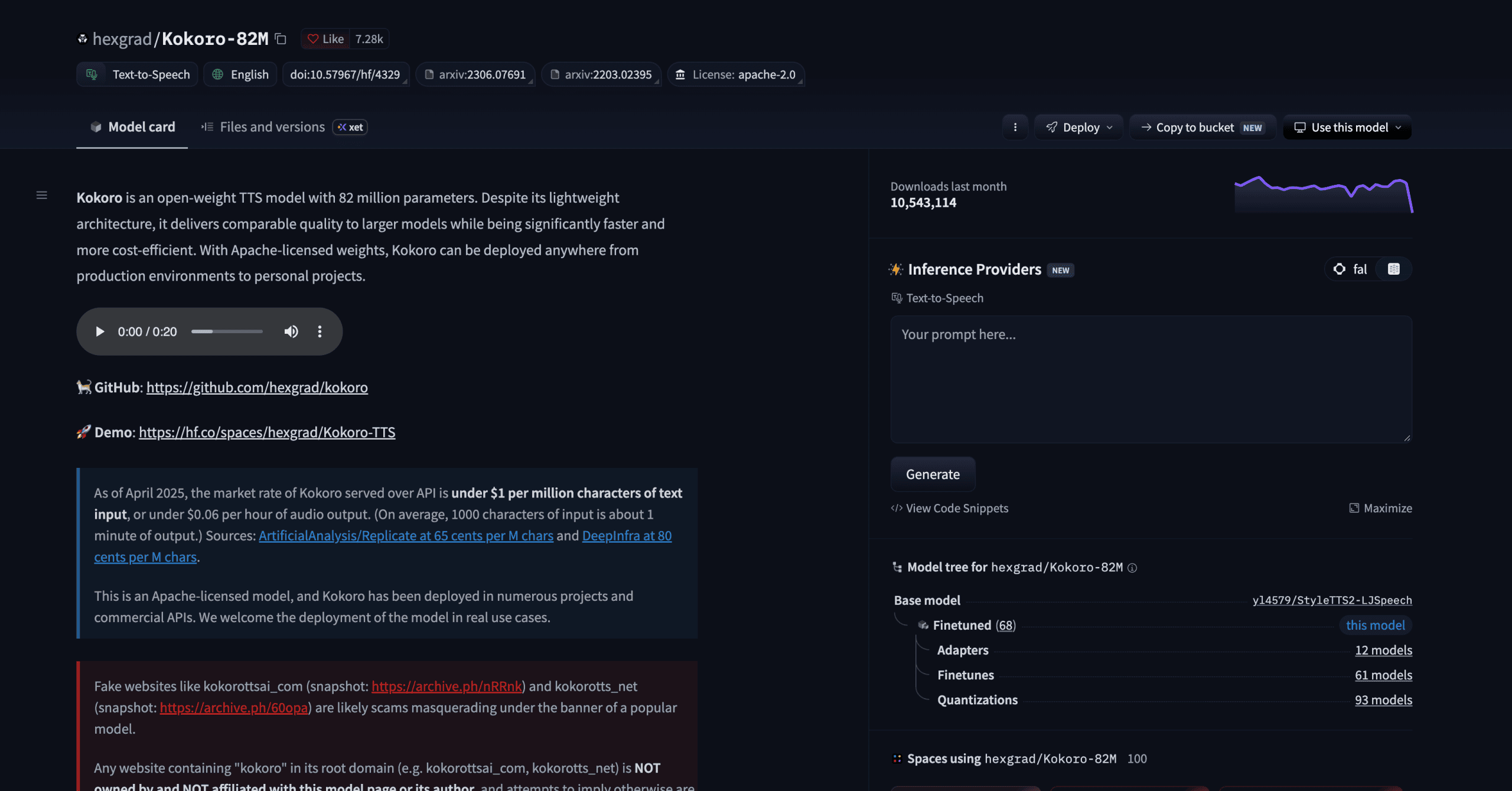
Size and license: 82 million parameters, Apache 2.0, about 327 MB of weights, per the model card.
The proof: At launch it ranked first on the TTS Spaces Arena, ahead of XTTS v2 (467M) and others, according to UnfoldAI. A 2026 roundup still ranks it sixth among open models on the Artificial Analysis Speech Arena (Elo 1,060). Its comparators are other TTS models, not chat LLMs.
Run it:
pip install "kokoro>=0.9.4" soundfileimport soundfile as sf
from kokoro import KPipeline
# "a" means American English; the language code must match the voice
pipeline = KPipeline(lang_code="a")
text = "Your invoice has been paid. Thank you for your business."
# The pipeline yields audio in chunks: text, phonemes, then the audio itself
for i, (graphemes, phonemes, audio) in enumerate(pipeline(text, voice="af_heart")):
sf.write(f"speech_{i}.wav", audio, 24000) # Kokoro outputs 24 kHz audioKPipeline handles text-to-phoneme conversion and voice loading, and af_heart is the voice used in the official example. Long text comes out as several WAV files, one per chunk, so join them if you need a single file.
The catch: It is not the leader anymore. The same roundup says NVIDIA's Magpie (357M) now outranks it, and Kokoro has no voice cloning.
Wrapping Up
You met seven small specialist models and what each one wins: Parakeet at transcription, PaddleOCR-VL at OCR, GLiNER at entity extraction, EmbeddingGemma at embeddings, Arch-Router at routing, Nemotron-Orchestrator-8B at tool decisions, and Kokoro at speech output. You saw the published proof, the license caveats, and runnable code for each, plus the limits that keep a giant LLM in the picture.
Now pick one job in your own stack, such as transcription or extraction, and swap in the matching specialist. Time it, score it against your current model on your own data, and keep the giant for what only it can do. If you try one, share your results.
Shittu Olumide is a software engineer and technical writer passionate about leveraging cutting-edge technologies to craft compelling narratives, with a keen eye for detail and a knack for simplifying complex concepts. You can also find Shittu on Twitter.