

5 Free Courses to Learn AI Engineering
Learn LLM fundamentals, AI engineering, RAG, MLOps, fine-tuning, and deployment with five practical courses designed to help you become a stronger AI and machine learning engineer.
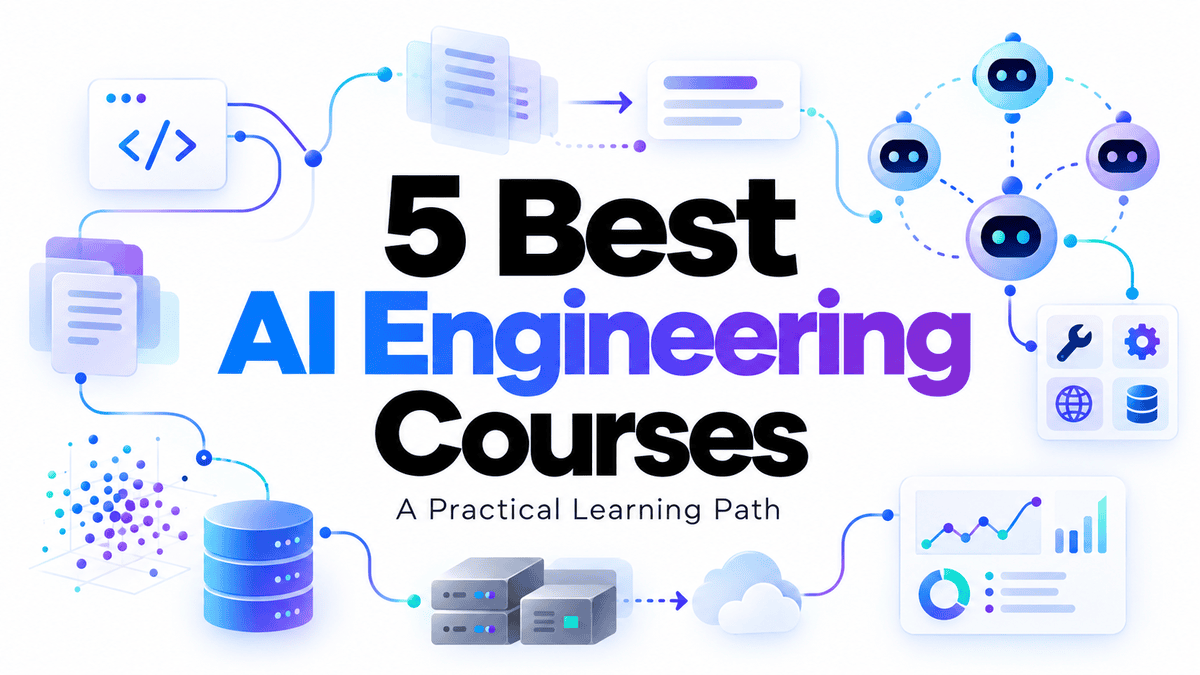
AI engineering sits somewhere between software engineering, machine learning, and generative AI.
As an AI engineer, you are not usually training a foundation model from scratch. Most of the time, you are taking existing models and figuring out how to turn them into useful applications and automated systems.
That can mean working with model APIs, embeddings, vector databases, retrieval-augmented generation (RAG), AI agents, multi-agent workflows, evaluation systems, model serving, monitoring, and deployment. You might build agents that use tools, coordinate with other agents, automate internal workflows, or handle parts of a larger business process.
The good thing is that you do not need an expensive bootcamp to learn all of this. Some of the best AI engineering courses are completely free and open-source, with lectures, notebooks, exercises, and projects available online.
I have ordered the following five courses from easiest to most difficult, so you can also follow them as a learning path and gradually build your skills.
1. Hugging Face Large Language Model Course
If you are relatively new to large language models (LLMs), I would start with the Hugging Face LLM Course.
The course starts with Transformer fundamentals and gradually moves into the Hugging Face ecosystem, including Transformers, Datasets, Tokenizers, Accelerate, and the Hugging Face Hub. You also learn how to fine-tune models, build demos, curate datasets, and work with reasoning models.
The curriculum includes:
- Transformer models
- Using Hugging Face Transformers
- Fine-tuning pretrained models
- Datasets and Tokenizers
- Classical natural language processing (NLP) tasks
- Building and sharing demos
- Dataset curation
- LLM fine-tuning
- Reasoning models
The course is completely free and requires good Python knowledge. Prior PyTorch or TensorFlow experience is helpful but not required.
What makes it a good starting point is that you learn how LLMs actually work before moving into higher-level areas such as RAG and AI agents.
Difficulty: Beginner to Intermediate
What you will learn: Transformers, tokenization, datasets, fine-tuning, and modern LLM workflows
Best for: Building a strong foundation in LLMs and Hugging Face
Course: Hugging Face LLM Course
GitHub: huggingface/course
2. AI Engineer Notebooks
If you want a more practical introduction to AI engineering, I would recommend the AI Engineer Notebooks repository.
It is a collection of hands-on Colab notebooks designed around the skills used in AI Engineer and Forward Deployed Engineer roles. Instead of relying heavily on frameworks, the notebooks teach you how to build core systems directly with model APIs.
The curriculum covers:
- Model APIs and structured outputs
- Tool calling
- RAG
- LLM evaluations
- AI agents
- Fine-tuning and LoRA
- Prompt injection and security
- LLMOps and reliability
- Model serving and inference
- Machine learning system design
- Case studies and capstone projects
One of the strongest parts of the course is that it is framework-free by design. You build agent loops, RAG pipelines, and evaluation systems from raw API calls first, which makes it easier to understand what higher-level frameworks are doing behind the scenes.
The notebooks are built to run primarily with the free Groq API, while GPU-heavy topics such as LoRA fine-tuning and self-hosted inference include optional Colab GPU exercises. The project is also open-source under the MIT License.
Difficulty: Intermediate
What you will learn: RAG, agents, evals, tool calling, LLMOps, fine-tuning, and production AI engineering
Best for: Developers who want hands-on AI Engineer or Forward Deployed Engineer skills
Course: GitHub-based notebook curriculum
GitHub: calmrocks/ai-engineer-notebooks
3. DataTalksClub Large Language Model Zoomcamp
If you want to learn how to build production-style LLM applications, I would recommend the DataTalksClub LLM Zoomcamp.
It is a free, hands-on course focused on building complete LLM systems rather than only learning model theory. The 2026 curriculum covers agentic RAG, vector search, orchestration, evaluation, monitoring, and a final capstone project.
The course covers:
- Agentic RAG
- Vector search and embeddings
- LLM orchestration
- RAG and agent evaluation
- Monitoring
- Production best practices
- Capstone project
What makes this course useful is that you build an application step by step and learn how retrieval, agents, evaluation, and monitoring fit together in a real system. The broader course also covers function calling, hybrid search, and reranking.
Difficulty: Intermediate
What you will learn: RAG, agents, vector search, evaluation, monitoring, and production LLM systems
Best for: Building practical, end-to-end LLM applications
GitHub: DataTalksClub/llm-zoomcamp
4. MLOps Zoomcamp
If you want to understand what happens after a machine learning model has been trained, I would recommend the DataTalksClub MLOps Zoomcamp.
This free course focuses on taking machine learning models from experimentation to production. You learn how to track experiments, manage models, build pipelines, deploy models, monitor them, and automate the surrounding infrastructure.
The curriculum includes:
- Experiment tracking with MLflow
- Model management
- Workflow orchestration
- Machine learning pipelines
- Online and batch deployment
- Model monitoring
- Testing and CI/CD
- Infrastructure as Code
- End-to-end MLOps project
The course assumes prior experience with Python, Docker, command-line tools, and basic machine learning. It is currently fully available for self-paced study, and DataTalksClub says there is no live cohort planned for 2026.
Difficulty: Intermediate
What you will learn: How to deploy, monitor, automate, and maintain machine learning systems in production
Best for: Data scientists and machine learning engineers moving into production machine learning
GitHub: DataTalksClub/mlops-zoomcamp
5. Maxime Labonne's Large Language Model Course
If you want to go deeper into open-source LLMs, fine-tuning, and model optimization, I would recommend Maxime Labonne's LLM Course.
The course is split into three tracks: optional LLM fundamentals, an LLM Scientist path focused on building and improving models, and an LLM Engineer path focused on creating and deploying LLM applications.
It covers topics such as:
- LLM fundamentals
- Fine-tuning and QLoRA
- DPO and ORPO
- Quantization
- GGUF and llama.cpp
- Model merging
- Inference optimization
- LLM applications and deployment
The repository also includes practical notebooks for fine-tuning models with tools such as Unsloth and Axolotl, quantizing models into formats such as GGUF, GPTQ, AWQ, and EXL2, and experimenting with model merging.
What makes this course stand out is its strong focus on open-source models and the techniques used to train, compress, optimize, and run them efficiently.
Difficulty: Intermediate to Advanced
What you will learn: Fine-tuning, quantization, model merging, inference, and open-source LLM engineering
Best for: Going deeper into how open-source LLMs are trained and optimized
GitHub: mlabonne/llm-course
Final Thoughts
If you are starting from scratch, I would begin with the Hugging Face LLM Course to understand Transformers, tokenization, inference, and fine-tuning.
From there, move into AI Engineer Notebooks and LLM Zoomcamp to start building real LLM applications. Once you are comfortable with that, take MLOps Zoomcamp to learn deployment, monitoring, pipelines, and production systems. Finally, use Maxime Labonne's LLM Course to go deeper into fine-tuning, quantization, inference optimization, and open-source models.
The important part is to keep building as you learn.
Even in a world where you can ask an AI coding agent to generate an application, fundamentals still matter. You need to understand the code, debug failures, make architecture decisions, deploy systems, monitor them, and know what to do when something breaks.
AI is making it easier to build software, but that does not remove the need for engineering skills. Companies still need strong software engineers, machine learning engineers, MLOps engineers, and infrastructure engineers who can take an idea all the way into production.
Use AI to move faster, but build enough knowledge and hands-on experience that you understand what the AI is building for you. That combination is what will make you a much stronger AI engineer.
Abid Ali Awan (@1abidaliawan) is a certified data scientist professional who loves building machine learning models. Currently, he is focusing on content creation and writing technical blogs on machine learning and data science technologies. Abid holds a Master's degree in technology management and a bachelor's degree in telecommunication engineering. His vision is to build an AI product using a graph neural network for students struggling with mental illness.