

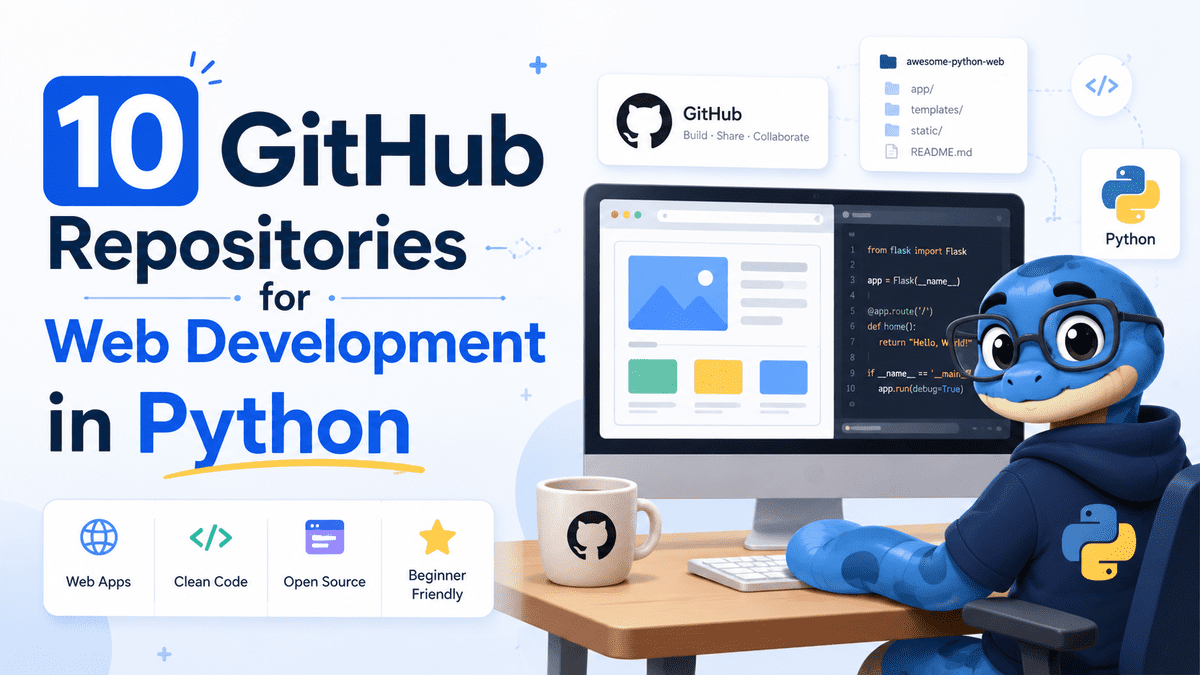
10 GitHub Repositories for Web Development in Python
Explore the best Python web development repositories for building APIs, full-stack web apps, dashboards, machine learning demos, internal tools, and interactive Python-based user interfaces.
# Introduction
Believe it or not, Python is used for web application and web development far more than many people think. I have seen many developers and teams use frameworks like Django and Flask to build internal systems, admin portals, dashboards, and fully functional websites.
Python is no longer just for scripting, automation, and data science. It has become one of the most practical choices for building APIs, dashboards, machine learning apps, internal tools, and full-stack web applications.
That being said, the Python web ecosystem has evolved a lot. Today, there are newer frameworks that make Python useful not only for backend development but also for building interactive frontends, data apps, visualizations, and simple web interfaces without needing a complex JavaScript setup.
In this article, we will review 10 Python repositories that make web development easier. We will cover frameworks for building APIs, full-stack web applications, dashboards, machine learning demos, internal tools, and Python-based user interfaces.
# 1. FastAPI
FastAPI is one of the most popular Python frameworks for building APIs. It is designed to be fast, easy to learn, and ready for production.
It is especially useful for developers who want to build REST APIs, backend services, AI application endpoints, or microservices. FastAPI also provides automatic interactive application programming interface (API) documentation, which makes testing and sharing endpoints much easier.
Best for: Building high-performance APIs
Why it is useful:
- High-performance API development
- Easy syntax using Python type hints
- Automatic API documentation
- Great for production-ready backend services
# 2. Django
Django is a powerful Python web framework designed for building complete web applications quickly. It follows the "batteries included" philosophy, meaning it comes with many built-in features such as authentication, admin panels, object-relational mapping (ORM), routing, security tools, and database management.
If you are building a content management system, software-as-a-service (SaaS) product, e-commerce platform, or large-scale web app, Django is one of the strongest options in the Python ecosystem.
Best for: Full-stack web applications
Why it is useful:
- Complete web framework
- Built-in admin interface
- Strong security features
- Great for large and scalable applications
# 3. Flask
Flask is a micro web framework for Python. Unlike Django, Flask gives you more flexibility and fewer built-in assumptions. This makes it a great choice for small applications, prototypes, APIs, and projects where you want more control over the structure.
Flask is beginner-friendly but also powerful enough for production applications when combined with the right extensions.
Best for: Lightweight web applications
Why it is useful:
- Lightweight and flexible
- Easy to learn
- Good for small apps and APIs
- Large ecosystem of extensions
# 4. Textual
Textual is a Python framework for building sophisticated user interfaces with a simple Python API. It allows you to create interactive applications that can run in the terminal and web browser.
This is useful for developers building developer tools, dashboards, command-line interfaces (CLIs), monitoring apps, and internal tools.
Best for: Terminal and browser-based user interfaces
Why it is useful:
- Build rich terminal applications
- Simple Python-based UI development
- Useful for developer tools and dashboards
- Can run apps in the terminal and browser
# 5. Django REST Framework
Django REST Framework is one of the most important tools in the Django ecosystem. It makes it easier to build web APIs on top of Django.
If you already use Django and want to expose your application data through REST APIs, Django REST Framework (DRF) provides serializers, authentication, permissions, viewsets, browsable APIs, and many other tools.
Best for: Building APIs with Django
Why it is useful:
- Powerful API framework for Django
- Built-in authentication and permissions
- Great for REST API development
- Works well with existing Django projects
# 6. Reflex
Reflex lets you build web applications using only Python. It is designed for developers who want to create interactive web apps without having to write frontend code in JavaScript.
With Reflex, you can define the frontend, backend, and application logic in Python. This makes it useful for Python developers who want to build full-stack applications quickly.
Best for: Full-stack web apps in pure Python
Why it is useful:
- Build full-stack apps in Python
- No need to write JavaScript manually
- Good for prototypes and internal tools
- Useful for Python-first developers
# 7. Taipy
Taipy is designed to help developers turn data and AI algorithms into production-ready web applications. It is especially useful for data scientists and machine learning engineers who want to create interactive applications around their models, workflows, and analytics.
Instead of keeping projects inside notebooks, Taipy helps you turn your work into applications that others can use.
Best for: Data and AI web applications
Why it is useful:
- Build data and AI applications
- Useful for productionizing analytics workflows
- Good for machine learning demos and tools
- Python-first application development
# 8. Streamlit
Streamlit is one of the most popular Python frameworks for building interactive web apps, especially for data science, machine learning, dashboards, and AI demos. It allows you to turn Python scripts into shareable web applications without needing frontend development experience.
It is especially useful for developers who want to quickly build data apps, visualization tools, reporting dashboards, large language model (LLM) demos, and machine learning interfaces using only Python.
Best for: Data apps and interactive dashboards
Why it is useful:
- Build interactive web apps in Python
- No frontend experience required
- Great for dashboards, reports, and AI demos
- Easy to share and deploy apps
- Strong choice for data science and machine learning projects
# 9. Gradio
Gradio is one of the easiest ways to build and share machine learning applications in Python. It allows you to create simple web interfaces for models, functions, APIs, and demos with just a few lines of code.
It is especially useful for showcasing machine learning models, testing prototypes, and sharing AI applications with non-technical users.
Best for: Machine learning demos
Why it is useful:
- Quick machine learning app development
- Simple Python interface
- Great for demos and prototypes
- Easy to share with others
# 10. Dash
Dash is a Python framework for building interactive data applications and dashboards. It is widely used by data scientists, analysts, and engineers who want to create web-based visualizations without writing JavaScript.
Dash works well with Plotly charts and is a strong choice for building analytical dashboards, reporting tools, and business intelligence applications.
Best for: Dashboards and data apps
Why it is useful:
- Build dashboards in Python
- No JavaScript required
- Works well with Plotly visualizations
- Great for data science and analytics projects
# Final Thoughts
Python has a rich and practical ecosystem for web development, and these repositories show how flexible it has become. Django and Flask are still strong choices, and I do have experience with both, but my use of them has mostly been limited compared to some of the newer Python-first frameworks.
For my own work, I use FastAPI when I need reliable API endpoints for machine learning models, backend services, and production-ready integrations. I use Gradio for quickly creating LLM and machine learning application demos, especially when I want to test or share a model with others. For data apps, dashboards, and interactive reports, Streamlit is one of the easiest tools to use.
The biggest shift for me has been Reflex. I previously leaned more toward Next.js for full-stack web applications, but Reflex made me move toward a more Python end-to-end workflow. Being able to build the frontend, backend, and application logic in Python makes it easier to stay in one ecosystem and move faster.
Overall, the best repository depends on what you want to build. If you want APIs, use FastAPI. If you want full-stack Python apps, try Reflex. If you want machine learning demos, use Gradio. If you want data apps, Streamlit is a great choice. And if you want a more traditional web development framework, Django and Flask are still worth learning.
Abid Ali Awan (@1abidaliawan) is a certified data scientist professional who loves building machine learning models. Currently, he is focusing on content creation and writing technical blogs on machine learning and data science technologies. Abid holds a Master's degree in technology management and a bachelor's degree in telecommunication engineering. His vision is to build an AI product using a graph neural network for students struggling with mental illness.